The SAMENA Telecommunications Council and the World WLAN Application Alliance (WAA) are strengthening their institutional cooperation through a series of industry engagements in Dubai, Muscat, and Shenzhen, bringing global WLAN technology development into closer contact with telecommunications infrastructure requirements, operator priorities, and investment opportunities across the South Asia, Middle East, and North Africa (SA-ME-NA) region.
The latest engagement took place in Shenzhen, China, where the SAMENA Council participated in the Third Meeting of the Second Council of WAA and the Global WLAN Industry Forum, held in conjunction with CEIC2026, the Consumer Electronics Innovation Conference & Exhibition, taking place from October 22 to 24. These engagements provided opportunities for institutional dialogue on WLAN industry development, emerging technologies, international cooperation, and the different market conditions affecting technology adoption and investment.
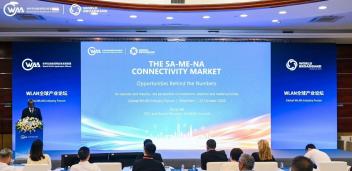
At the Global WLAN Industry Forum, Bocar A. BA, CEO of the SAMENA Council, delivered a featured presentation titled “The SA-ME-NA Connectivity Market: Opportunities Behind the Numbers.” The presentation offered an operator and industry perspective on the different infrastructure, investment, and commercial conditions shaping technology adoption across the Gulf, South Asia, and North Africa.
BA noted: “The Gulf represents an advanced connectivity environment, supported by substantial investments in fiber, 5G, cloud infrastructure, data centers, and major digital development projects. These investments create opportunities for advanced WLAN solutions, particularly in airports, hospitality, healthcare, enterprise campuses, industrial facilities, and large urban developments. However, operators and enterprises must also determine where new solutions fit within their existing infrastructure and whether additional investment can deliver measurable improvements.”
In this context, AI-assisted WLAN capabilities, including interference management, fault identification, service consistency, network security, and operating efficiency, offer areas for practical consideration. However, commercial relevance may depend on actual operational requirements, integration costs, and demonstrable improvements in performance and service quality. For operators that have already committed substantial capital to existing infrastructure, technology adoption must be supported by clear operational or commercial benefits.
Different conditions apply across South Asia, the Middle East, and North Africa. In South Asian markets such as Pakistan and Bangladesh, population scale creates substantial connectivity requirements, while affordability, deployment costs, energy consumption, and maintenance remain important factors in technology adoption. In North Africa, broadband modernization, evolving spectrum policies, and different infrastructure investment cycles influence the timing and commercial viability of new connectivity solutions. Spectrum policy is another important consideration for WLAN development. National decisions concerning the 6 GHz band, including different approaches in Saudi Arabia, the UAE, and Egypt, illustrate how regulatory conditions affect technology deployment and investment planning. At the same time, global WLAN standards, interoperability, common measurements, and compatibility between network-management systems are becoming increasingly important as AI is applied to WLAN operations. These regional considerations have direct implications for cooperation between WAA and the SAMENA Council.
For the SAMENA Council, cooperation with WAA forms part of its ongoing institutional engagement with telecommunications operators, regulators, technology companies, and international industry organizations. The Council is supporting closer exchanges between regional stakeholders and the global WLAN technology community, with particular attention to the commercial and operational requirements that determine whether new connectivity solutions can be adopted successfully.
The Dubai (DCF forum), Muscat (AXIS conference), and Shenzhen (Global WLAN forum) engagements collectively reflect growing opportunities for cooperation between China's technology industry and telecommunications markets across the SA-ME-NA region. The Council views this as a means to help technology providers better understand regional infrastructure and investment conditions, enable telecom operators to examine solutions against practical network requirements, and support greater alignment between international WLAN development, industry standards, and regional deployment experience.
Source: SAMENA Council Press Release