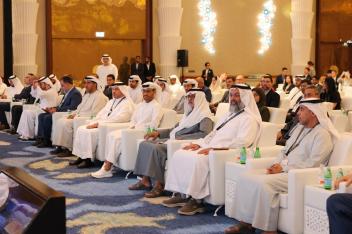
The SAMENA Telecommunications Council successfully convened the Leaders’ Summit 2026 at Atlantis – The Palm, Dubai, under the theme “Intelligent Networks for Sovereign & Sustainable Futures.”
Held at a time of heightened regional sensitivity, the Summit brought together senior leaders from across telecommunications, technology, policy, and investment communities. Participation, both in-person and virtual, reflected a clear and shared industry position: maintaining engagement is essential to ensure continuity in infrastructure development, service delivery, and long-term investment planning across the region.
The Leaders’ Summit 2026 was held in legacy collaboration with Huawei and with chief patronage and guidance of the Telecommunications and Digital Government Regulatory Authority (TDRA). The convening of stakeholders across public and private sectors reaffirmed the importance of structured dialogue in enabling coordinated responses to evolving market, policy, and operational conditions, while also demonstrating continued confidence in the UAE as a stable environment for industry collaboration.
H.E. Sheikh Nahyan bin Mubarak Al Nahyan, UAE Minister of Tolerance and Coexistence, as Guest of Honor, congratulated the SAMENA Council on its industry role over the past twenty years and reflected on its role in advancing cooperation, dialogue, and regional digital development. His remarks placed emphasis on the growing importance of digital systems in supporting economic resilience, national /.decision-making, and societal stability, while highlighting the need for governance frameworks that ensure trust, security, and long-term sustainability.
From an industry standpoint, this direction translates into a clear set of priorities. Digital infrastructure must be resilient, capable of operating under stress, and supported by regulatory clarity. Systems must be trusted by users, enterprises, and governments alike. Progress depends on sustained partnership across borders and sectors. At the same time, technology policy must remain grounded in practical outcomes, ensuring that innovation contributes to economic growth, operational stability, and societal benefit.
The Leaders’ Summit was marked by strong participation from telecom operators, satellite operators, regulators, global technology providers, media, and international organizations. Sessions addressed key developments shaping the digital sector, including the evolution toward 5G-Advanced, the integration of artificial intelligence into networks and industrial systems, and the emergence of new connectivity models through the convergence of terrestrial, satellite, and direct-to-device capabilities.
A central theme across discussions was the increasing complexity of the operating environment for telecom operators. While demand for data and digital services continues to grow, operators are navigating rising investment requirements, evolving regulatory expectations, and the need to establish sustainable revenue models. The discussions reflected a shift toward value creation through enterprise solutions, digital platforms, and sector-specific applications that build directly on existing infrastructure investments. Artificial intelligence featured prominently throughout the Summit, reflecting its transition from experimental use cases to operational deployment. Discussions addressed governance, accountability, and alignment with national priorities, with the concept of Sovereign AI examined as a framework through which AI systems can operate within defined regulatory and operational boundaries while delivering measurable outcomes.
The Summit also addressed the continued evolution of telecom operators into broader technology-driven entities, alongside changes in connectivity architecture. The integration of terrestrial networks with satellite systems, combined with the development of direct-to-device capabilities, is extending coverage and improving resilience. These developments require closer coordination across industry and policy domains, particularly in spectrum management, standards alignment, and operational interoperability.
In this context, the upper 6 GHz band emerged as a key area of dialogue. Participants emphasized the importance of aligning spectrum allocation decisions with long-term capacity requirements and evolving ecosystem needs. At the same time, increasing satellite activity has brought greater attention to orbital governance and space sustainability, both of which are becoming immediate considerations in network planning and regulatory frameworks.
A dedicated CEO-level engagement examined how leadership decisions are shaping the future of digital infrastructure and economic participation. The session reflected how executive strategy is increasingly required to align technological deployment with regulatory, commercial, and operational realities. Practical applications of artificial intelligence, including digital twins, were demonstrated as tools supporting planning, optimization, and decision-making at the leadership level.
Commenting on the outcomes of the SAMENA Council Leaders’ Summit, Bocar BA., CEO and Board Member of the SAMENA Council, noted that convening under current regional conditions carried particular significance. He emphasized that continued engagement among stakeholders is necessary to maintain progress in infrastructure development, policy alignment, and industry collaboration. “The discussions held at this Leaders’ Summit reflect a clear understanding that the sector must continue to move forward, even in complex circumstances. Digital infrastructure today supports critical functions across economies and societies, and its development cannot be deferred. What is required is closer coordination, practical alignment, and a sustained commitment to building on the strong foundations already in place,” he stated.
The Leaders’ Summit 2026 reaffirmed the SAMENA Council’s role as a platform that brings together public and private sector stakeholders to address shared challenges and opportunities. Its outcomes are expected to contribute to advancing regional and international discussions on spectrum policy, AI governance, connectivity models, and investment in digital infrastructure.
As the industry continues to evolve, the Leaders’ Summit remains a forum for aligning priorities, strengthening partnerships, and ensuring that technological progress translates into tangible economic and societal value across the region, supported by active collaboration between governments and the private sector.
Source: Press Release