


Page 7 - SAMENA Trends - September 2026
P. 7
SAMENA COUNCIL ACTIVITY  SAMENA TRENDS


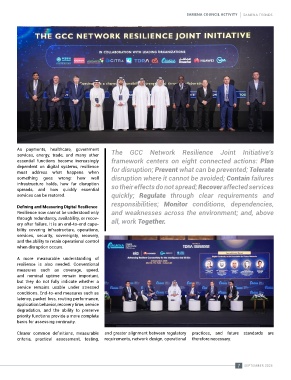
        As payments, healthcare, government     The  GCC Network Resilience  Joint Initiative’s
        services, energy, trade, and many  other
        essential  functions  become  increasingly   framework  centers  on eight  connected  actions:  Plan
        dependent  on digital  systems, resilience   for disruption; Prevent what can be prevented; Tolerate
        must address what happens when
        something  goes   wrong:  how  well     disruption where it cannot be avoided; Contain failures
        infrastructure holds, how far  disruption   so their effects do not spread; Recover affected services
        spreads,  and how quickly essential
        services can be restored.               quickly;  Regulate through  clear requirements  and
                                                responsibilities;  Monitor conditions,  dependencies,
        Defining and Measuring Digital Resilience
        Resilience now cannot be understood only   and weaknesses across the environment; and, above
        through redundancy, availability, or recov-  all, work Together.
        ery after failure. It is an end-to-end capa-
        bility covering  infrastructure, operations,
        services, security,  sovereignty,  recovery,
        and the ability to retain operational control
        when disruption occurs.

        A  more  measurable understanding of
        resilience  is  also needed.  Conventional
        measures such  as  coverage, speed,
        and nominal uptime remain important,
        but they do not fully indicate  whether  a
        service remains  usable under  stressed
        conditions. End-to-end measures such as
        latency, packet loss, routing performance,
        application behavior, recovery time, service
        degradation,  and the ability  to preserve
        priority functions provide a more complete
        basis for assessing continuity.

        Clearer  common  definitions,  measurable   and greater alignment between regulatory   practices,  and  future standards are
        criteria,  practical assessment, testing,   requirements, network design, operational   therefore necessary.


                                                                                                     7  SEPTEMBER 2026

