


Page 12 - SAMENA Trends - September 2026
P. 12
SAMENA COUNCIL ACTIVITY  SAMENA TRENDS

        Preparing  Today’s  Infrastructure for 6G   provided  an opportunity for WAA and   systems.  These  requirements  carry
        and Future Networks                  regional stakeholders, particularly regional   both policy  and  business implications.
        Preparation  for 6G begins  well before   operators, to establish direct engagement   Investment in continuity,  cybersecurity,
        commercial deployment. Decisions being   and  consider  areas  for  continued  route diversity,  backup systems,  recovery
        made  today  around  architecture,  fiber,   interaction.                capability,  and automation should be
        computing, automation, security, spectrum,                               assessed against the operational, financial,
        standards, and power infrastructure  will   Conclusively, digital continuity increasingly   and wider economic cost of disruption and
        shape future network capability.     depends  on knowing what  must  be   prolonged  recovery.  Resilience  therefore
                                             protected,  understanding  where critical   needs  to  be  defined,  measured,  tested,
        Deep  fiber  deployment  is  an  important   dependencies  lie, ensuring  that  essential   and built into infrastructure, operations,
        foundation for future networks, extending   services can continue  under  degraded   regulation,  and investment  decisions
        from backbone  and metro infrastructure   conditions, maintaining operational control   before  disruption occurs,  with  digital
        toward the radio-access edge. Distributed   as  networks  become  more autonomous,   continuity  ultimately  demonstrating
        computing  and more automated network   and preparing  across sectors and   whether those capabilities hold when they
        operations will also place greater demands   jurisdictions  rather than within isolated   are needed.
        on power availability, energy  storage,
        operational  efficiency,  and  infrastructure
        continuity.

        Spectrum  availability  and regulatory
        preparation are equally important. Flexible
        licensing,  terrestrial  and non-terrestrial
        coordination,  early spectrum  planning,
        and regional alignment will influence how
        effectively  future network technologies
        can be introduced.

        Early  deployment  alone  does  not  create
        commercial success. Experience  from
        previous network generations shows
        that deployment  must be accompanied
        by viable use cases, enterprise  demand,
        sustainable investment models, and clear
        commercial value.

        Future-network  readiness  therefore
        depends  on decisions  already being
        made around  infrastructure investment,
        spectrum,  energy,  security,  standards
        participation,  operational models, and
        commercial viability.


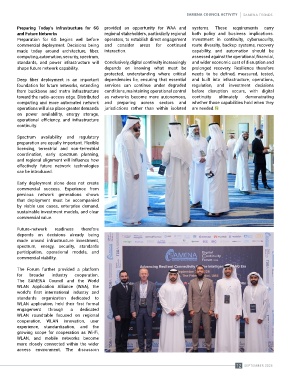
        The Forum further provided a  platform
        for  broader   industry  cooperation.
        The SAMENA Council  and the World
        WLAN Application Alliance (WAA),  the
        world’s  first  international  industry  and
        standards  organization  dedicated to
        WLAN  application,  held  their  first  formal
        engagement   through   a  dedicated
        WLAN  roundtable  focused  on  regional
        cooperation,  WLAN  innovation,  user
        experience,  standardization, and the
        growing scope  for cooperation  as  Wi-Fi,
        WLAN, and mobile networks  become
        more closely connected  within the wider
        access environment. The discussion


                                                                                                    12  SEPTEMBER 2026

