


Page 86 - SAMENA Trends - September 2026
P. 86
REGIONAL & MEMBERS UPDATES  SAMENA TRENDS

        Health and safety provisions add another   into Pakistan. The PTA said the regulations   equipment  vendors  and operators with  a
        layer of compliance for equipment entering   were developed  following  consultations   clearer technical baseline  when planning
        commercial and operational environments.   with  licensees,  importers, manufacturers,   procurement  and deployment. The PTA
        The regulations  extend beyond  telecom   vendors  and other industry  stakeholders.   said  the  regulations are also  intended
        network operators. Manufacturers and   The authority said  the framework is   to  encourage local manufacturing and
        importers  are  also  covered, meaning   intended  to  promote  compatibility  contribute  to technological  advancement
        compliance requirements will apply earlier   and interoperability  with  international   and economic  growth.  For domestic
        in  the equipment  supply chain rather   telecommunications  systems  while  manufacturers, however,  the practical
        than only when hardware is installed by   improving service standards. Standardizing   impact  will  depend  on  how  certification,
        a  licensed  telecom  provider.  This  could   technical  requirements  can help reduce   testing  and compliance  processes  are
        have implications  for vendors  supplying   the risk of incompatible, poorly performing   implemented  and  whether local  testing
        network infrastructure, radio equipment   or non-compliant equipment entering   infrastructure is available at an appropriate
        and other  telecommunications hardware   national networks. It  can also provide   cost.


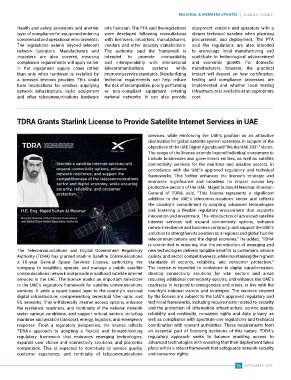
        TDRA Grants Starlink License to Provide Satellite Internet Services in UAE


                                                               services, while reinforcing the UAE’s  position as  an  attractive
                                                               destination for global satellite system operators, in support of the
                                                               objectives of the UAE Digital Agenda and “We the UAE 2031” vision.
                                                               The scope of the license extends beyond individual consumers to
                                                               include businesses and government entities, as well as satellite
                                                               connectivity  services for the maritime  and aviation sectors,  in
                                                               accordance  with the UAE’s approved regulatory  and technical
                                                               frameworks.  This  further enhances the license’s  strategic and
                                                               economic  significance  and  broadens  its  impact  across  key
                                                               productive sectors of the UAE. Majed Sultan Al Mesmar, Director-
                                                               General  of  TDRA,  said,  ”This  license  represents  a  significant
                                                               addition  to the UAE’s telecommunications  sector  and reflects
                                                               the country’s  commitment  to adopting  advanced  technologies
                                                               and  fostering a  flexible regulatory  environment that  supports
                                                               innovation and investment. The introduction of advanced satellite
                                                               internet  services will  expand  connectivity  options,  enhance
                                                               network resilience and business continuity, and support the UAE’s
                                                               ambition to strengthen its position as a regional and global hub for
                                                               telecommunications and the digital economy.” He added, “TDRA
                                                               is committed to ensuring that the introduction of emerging and
        The  Telecommunications  and Digital Government  Regulatory   new technologies delivers tangible benefits to customers, service
        Authority (TDRA) has granted Starlink Satellite Communications   quality, and sector competitiveness, while maintaining the highest
        a  10-year General  Space  Services License,  authorizing  the   standards of security,  reliability, and consumer  protection.”
        company  to establish,  operate, and manage a  public  satellite   The  license  is expected  to contribute  to digital transformation,
        communications network and provide broadband satellite internet   develop  connectivity  solutions  for vital  sectors  and areas
        services in the UAE. The license marks an important milestone   requiring additional connectivity options, and enhance the UAE’s
        in the UAE’s regulatory framework for satellite communications   readiness to respond to emergencies and crises, in line with the
        services. It  adds  a  space-based layer to the country’s  national   country’s national visions and strategies. The services covered
        digital  infrastructure,  complementing  terrestrial  fiber-optic  and   by the license are subject to the UAE’s approved regulatory and
        5G networks. This will diversify internet access options, enhance   technical frameworks, including requirements related to security
        the resilience, readiness, and continuity of the national network   and the protection of information infrastructure, service quality,
        under various conditions, and support critical sectors including   reliability  and continuity,  consumer rights and data  privacy,  as
        maritime and aviation transport, energy, logistics, and emergency   well as compliance with spectrum-use regulations and technical
        response.  From a  regulatory  perspective, the license  reflects   coordination with relevant authorities. These requirements form
        TDRA’s  approach  to  adopting  a  flexible and forward-looking   an  essential  part  of  licensing  decisions  of  this  nature.  TDRA’s
        regulatory framework that embraces  emerging  technologies,   regulatory  approach seeks  to  balance enabling  access to
        expands  user choice  and connectivity  solutions,  and promotes   advanced technologies with ensuring that their deployment takes
        competition.  This is  expected  to  contribute  to  service quality,   place within a robust framework that safeguards network security
        customer  experience,  and continuity of telecommunications   and consumer rights.

                                                                                                    86  SEPTEMBER 2026

