


Page 111 - SAMENA Trends - September 2026
P. 111
SAMENA REGULATORY DASHBOARD   SAMENA TRENDS

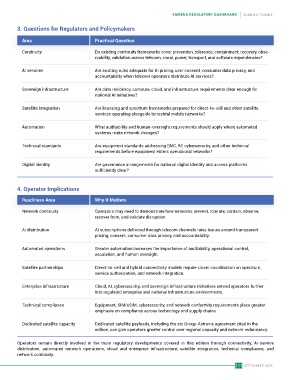
        3. Questions for Regulators and Policymakers


          Area                           Practical Question

          Continuity                     Do existing continuity frameworks cover prevention, tolerance, containment, recovery, obse-
                                         rvability, validation across telecom, cloud, power, transport, and software dependencies?


          AI services                    Are existing rules adequate for AI pricing, user consent, consumer data privacy, and
                                         accountability when telecom operators distribute AI services?

          Sovereign infrastructure       Are data residency, compute, cloud, and infrastructure requirements clear enough for
                                         national AI initiatives?

          Satellite integration          Are licensing and spectrum frameworks prepared for direct-to-cell and other satellite
                                         services operating alongside terrestrial mobile networks?

          Automation                     What auditability and human-oversight requirements should apply where automated
                                         systems make network changes?

          Technical standards            Are equipment standards addressing EMC, RF, cybersecurity, and other technical
                                         requirements before equipment enters operational networks?

          Digital identity               Are governance arrangements for national digital identity and access platforms
                                         sufficiently clear?


        4. Operator Implications

          Readiness Area                 Why It Matters

          Network continuity             Operators may need to demonstrate how networks prevent, tolerate, contain, observe,
                                         recover from, and validate disruption.

          AI distribution                AI subscriptions delivered through telecom channels raise issues around transparent
                                         pricing, consent, consumer data privacy, and accountability.

          Automated operations           Greater automation increases the importance of auditability, operational control,
                                         escalation, and human oversight.

          Satellite partnerships         Direct-to-cell and hybrid connectivity models require closer coordination on spectrum,
                                         service authorization, and network integration.


          Enterprise infrastructure      Cloud, AI, cybersecurity, and sovereign infrastructure initiatives extend operators further
                                         into regulated enterprise and national infrastructure environments.

          Technical compliance           Equipment, SIM/eSIM, cybersecurity, and network conformity requirements place greater
                                         emphasis on compliance across technology and supply chains.


          Dedicated satellite capacity   Dedicated satellite payloads, including the stc Group-Astranis agreement cited in the
                                         edition, can give operators greater control over regional capacity and network redundancy.


        Operators remain directly involved in the main  regulatory  developments  covered in this edition  through  connectivity, AI-service
        distribution,  automated  network  operations,  cloud  and enterprise infrastructure,  satellite integration,  technical  compliance, and
        network continuity.

                                                                                                    111  SEPTEMBER 2026

